
Your truck has to hold its speed on the loaded climb. The awkward part may be a long climb after several loaded runs, or a battery installation that leaves too little payload for the job. Horsepower on a 2026 specification sheet won’t tell you whether it can. We need to know the load and the length of the climb before a power rating becomes useful.
The route gives power its meaning
Peak power answers a short-duration question. A loaded vehicle climbing for several minutes raises a different one: how much output remains available as temperatures rise? A specification without operating duration and cooling conditions leaves that question open. Keep the loaded mass and target speed on the comparison sheet. Without those two entries, you can end up crediting a motor for an advantage that comes from the gearing.
A grade calculation gives your team a useful first check. Suppose your loaded vehicle weighs 40,000 kg and must hold 60 km/h on a 3% slope. Converting the speed to 16.67 m/s, the calculation is 40,000 × 9.81 × 0.03 × 16.67, which gives roughly 196 kW just to gain height. That is wheel power for gravity alone. Tires, air resistance and transmission losses still need accounting for. We’re using an illustrative vehicle here, not reporting a road test.
Duration is the next entry in that calculation: how long must the truck keep climbing? Your route assessment therefore needs loaded mass, grade duration and target speed together. A motor’s peak rating cannot establish the sustainable speed up that hill. Battery discharge limits and the cooling circuit belong in the same calculation.
Torque must reach the road at the required speed
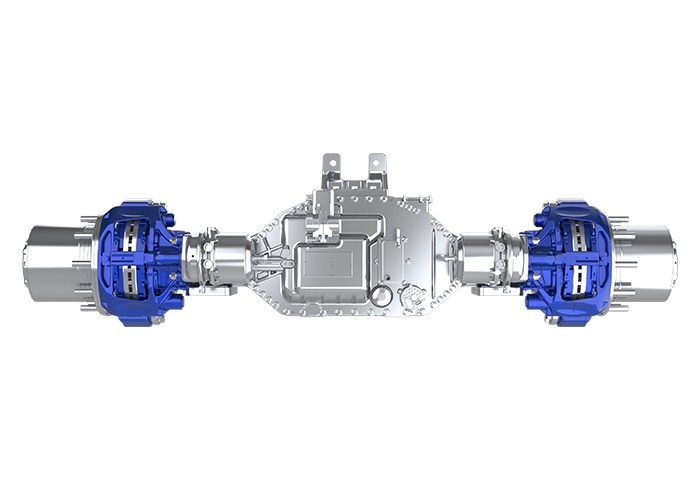
Axle torque explains a different part of the job. For a first estimate, divide axle-output torque by the tire’s effective rolling radius to obtain wheel force. Grip sets a separate ceiling. Read the torque curve at your required speed. Its highest point may occur at a speed the vehicle has already passed by the time it reaches the demanding part of the route.
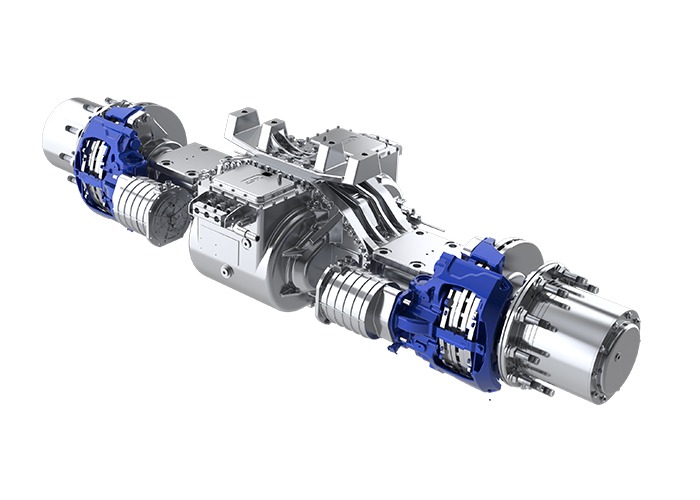
An electric drive unit for a vehicle must fit this operating envelope. CDTL’s single-motor EA3800N illustrates how several specifications matter alongside power. The following values describe the axle family; configuration choices require confirmation for the actual vehicle.
|
EA3800N characteristic |
Specified value |
Meaning for integration |
|---|---|---|
|
Maximum output torque |
38,483 Nm |
Check available wheel force with the selected tires |
|
X-dimension |
711 mm |
Check the installation envelope against the chassis drawing |
|
Assembly weight |
780–830 kg, configuration dependent |
Include the selected assembly in axle-load and payload calculations |
|
Rated voltage options |
600/800 VDC |
Match the selected version to the electrical architecture |
The 711 mm envelope goes onto your chassis drawing. Check what occupies the space around it when the suspension moves, where the coolant lines run, and how a technician reaches the service points. For torque, return to the curve and the allowed operating duration. Neither number replaces those checks when we discuss a vehicle configuration.
Cooling and electrical limits set the working envelope
Cooling becomes a route requirement as soon as the loaded run lasts longer than a brief acceleration. The U.S. Department of Energy lists the thermal system separately from the controller responsible for electrical flow and motor output. We keep that distinction in the truck assessment too. Your chosen motor still depends on sufficient battery discharge power and cooling capacity throughout the run.
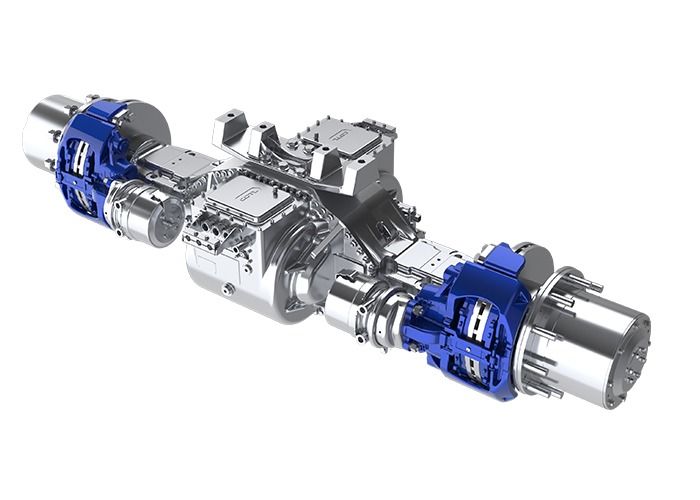
A battery electric vehicle powertrain also needs room to work. CDTL’s dual-motor EA5000N uses water-cooled motors and an integrated axle layout intended to free chassis space for underfloor batteries. That arrangement creates a packaging opportunity. Underfloor space has to include battery protection and access for removal. Draw those in before checking ground clearance and the resulting load on each axle.
A second loaded run may begin where the first one ended: with warm coolant and less battery charge. That makes successive runs useful for checking a shift requirement. Keep the payload and speed target unchanged, note the ambient temperature, and log coolant temperatures and battery state of charge. If the controller reduces power, record the point on the route and the speed the truck can still hold.
Vehicle layout changes what counts as a good powertrain
Application fit can outweigh a larger power figure. A bus needs passenger and body space that a tractor doesn’t, while vocational equipment may need a power take-off. These requirements change the value of the same axle characteristics before any efficiency comparison begins.
An electric rear axle developed for a particular bus layout makes that distinction tangible. The EA3400N is intended for non-low-floor buses over 10 meters, with a compact X-dimension supporting short rear-overhang layouts. That application doesn’t establish suitability for a fully low-floor bus. Body geometry remains an engineering requirement even when output appears sufficient.
Your energy log needs a measurement boundary as well as a number. A charger-meter reading includes energy that never leaves the battery as useful traction power. A battery discharge reading starts further along the path. Compare like with like, with the same payload, route, speed and auxiliary loads. A motor-efficiency figure describes one conversion stage. It doesn’t account for every loss or accessory demand across a working shift.
A useful powertrain comparison ends with the duty cycle
A route-ready configuration has evidence behind its operating margin. We need the loaded climb requirement beside the output curve, and the installation drawing beside the axle specification. Use those same load and speed assumptions for the assembled vehicle’s route validation, so the test answers the question that drove the design. That turns a brochure comparison into evidence your transport plan can use.
FAQ
Does more horsepower always mean a faster loaded truck?
No. The faster truck on a brief acceleration run may lose speed on a long ascent once a thermal or electrical limit reduces output. A higher peak rating alone doesn’t resolve those limits.
Can axle torque be compared directly with motor torque?
You need the gearing between the two measurement points. Reduction multiplies the motor’s torque, with some power lost in transmission, before the output reaches the axle. Two values in Nm can therefore describe very different wheel-force capabilities.
Does an 800 V system automatically use less energy?
No. We can’t calculate a shift’s energy use from the voltage label. You still need a route measurement, with heating, cooling and other auxiliary demands included on the same basis for both vehicles.
Is regenerative braking available at its maximum all the time?
No. Recovery depends on somewhere for the electricity to go. When the battery limits charging power, friction brakes must cover more of the braking demand. Available tire grip remains a separate constraint on deceleration.
What should accompany a supplier’s power rating?
Ask how long the quoted output lasts and for the curve showing where it is available. Cooling conditions and battery or inverter restrictions should accompany that curve. Those details let your engineering team relate the number to the loaded route.