
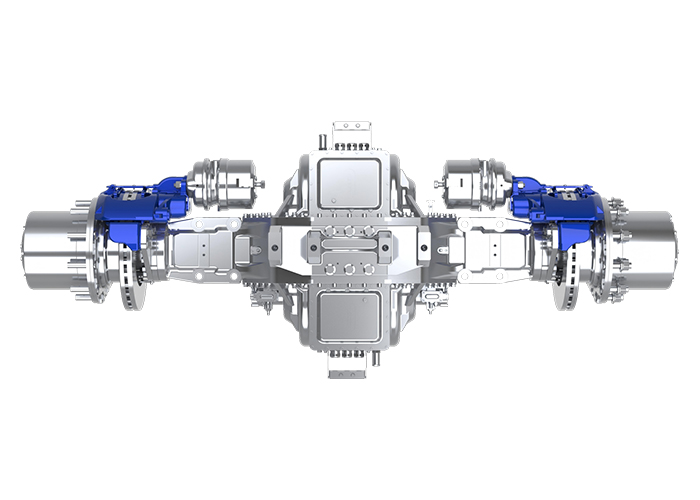
The heavy-duty vehicle industry is accelerating toward full electrification, and 2026 is emerging as a defining year for this transformation. As original equipment manufacturers (OEMs) evaluate the trade-offs between central drive systems and in-wheel motors, a new front-runner—high-integration electric drive axles (commonly called e-axles)—is reshaping the future of EV powertrains. The shift is being driven by both technical evolution and economic necessity. This article examines the reasons behind this pivot, exploring how integrated e-axles are outperforming legacy systems and how suppliers are enabling this transition through advanced electric drive system innovations.
Why Are Heavy-Duty Manufacturers Reconsidering Central Drive Systems?
So, why integrated e-axles? To better understand why integrated e-axles are gaining popularity, we first need to highlight some of the key characteristics of central drive designs and their constraints found in first generation heavy-duty EV architectures.
The Traditional Central Drive Architecture
Historically the central drive design has been preferred for its modular and chassis friendly features. The typical configuration for a central drive includes a motor, gearbox and differential as a single unit and the torque is transmitted via prop shafts as before. This configuration made early electrification of vehicles easy, but it also brings a lot of weight and complexity to vehicles and thus negates the efficiency advantage.
Technical Limitations in Modern Applications
SAE International research has found that energy losses in mechanical transmission components can reach 8–10 %. The space intensive design of mechanical transmissions in hybrid and electric vehicles further limits the effective dimensioning of batteries and of cooling systems. In addition, the large number of moving parts in hybrid and electric vehicles needs to be regularly lubricated and inspected, which results in increased down-time for fleets.
Economic Implications for Fleet Operators
For operators managing large fleets, maintenance costs quickly accumulate. Frequent servicing cycles elevate total cost of ownership (TCO), while limited scalability across different vehicle classes constrains manufacturing efficiency. As electrification scales up globally, these inefficiencies become more pronounced, pushing OEMs to seek cleaner, simpler drivetrain architectures.
What Makes In-Wheel Motors Appealing Yet Challenging for Heavy-Duty Use?
In-wheel motors are amongst the most recent technologies for decentralized drivetrain design. Their application in heavy-duty vehicles, however, appears to be of rather mixed nature.
Benefits of In-Wheel Motor Configurations
In-wheel motors can be managed individually allowing for improved traction control and torque vectoring in urban environments for buses and last-mile delivery vehicles. Traditional axle and differential components can be removed from the drivetrain in order to reduce losses and improve turning for the vehicle in tight spaces.
Engineering Barriers to Widespread Adoption
Direct mounting of the electric motor within the wheel is subject to shocks from irregular road surfaces and damage from objects on the road, an aspect which for long-distance trucks is not tolerable. The space near the wheel hub is extremely limited; consequently, an effective cooling system is not feasible. Increased unsprung mass negatively affects comfort and the properties of the suspension on rough roads.
Where In-Wheel Motors Fit Best Today
Early in-wheel motor applications are focused on light commercial vehicles and low-speed logistics in areas where agility is more important than durability. Airport shuttles and port vehicles are good examples of early adopters that operate in well-defined routes and conditions.
Why Are Integrated E-Axles Emerging as the Preferred Solution?
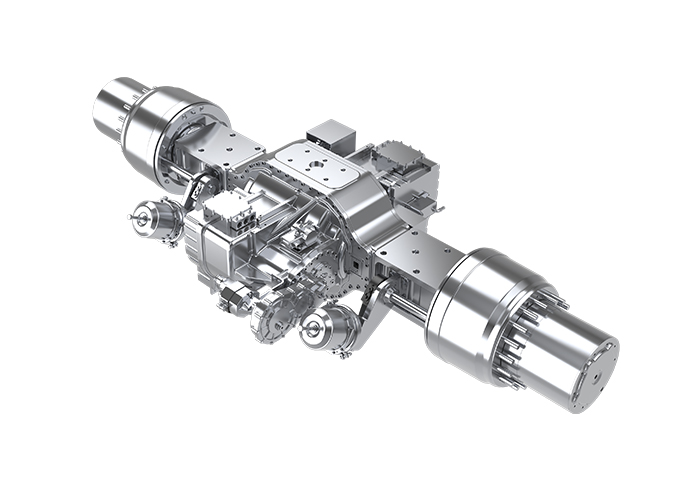
Both central drives and in-wheel solutions have their advantages and disadvantages. The integrated e-axle, however, offers a suitable balance of compactness and robustness for heavy-duty use in electric vehicles.
The Concept Behind High-Integration Electric Drive Axles
High-integration electric drive axle combines a motor, inverter, gearbox and differential into a single housing. Installed directly on the axle beams, such systems have the key advantage of very small wiring harnesses and a minimum of mechanical linkages. All the components can also be provided with shared cooling systems, essential in continuous operation to ensure good thermal properties.
Performance Advantages Over Legacy Systems
AVL Powertrain Systems released its 2023 report on Powertrain Electrification. Integrated e-axles in cars achieve an efficiency increase of up to 5–8% in comparison to central drives. Also the weight saving leads to around 6% lower energy consumption in driving. Thanks to their smaller space requirement integrated e-axles enable a more flexible battery packaging. This allows car manufacturers to increase the range of their cars or to optimize the aerodynamics while keeping the payload.
Cost Efficiency and ROI Considerations for Fleets
Financial benefits for the integration of steering gear and thruster units result in an easier and faster assemblage of up to 20 % within less time and with less costs. The less moving parts and the sealed lubrication units of the Thruster Units result in longer maintenance intervals. The improved financial benefits in terms of energy savings in relation to the typical 3 to 4 years’ lifecycle of a fleet, clearly indicates an additional high ROI potential in comparison with conventional systems.
How Is the Market Transitioning Toward E-Axle Dominance by 2026?
Based on the global market development, in the near future, e-axle technology will become mainstream for new heavy-duty EV platforms as market requirements increase for performance while regulations are becoming more stringent.
Industry Trends Driving Adoption Rates
Analysts from Global Market Insights forecast that the heavy-duty e-drive axle market will expand at a compound annual growth rate exceeding 25% through 2026. OEMs are aligning product pipelines with stricter emissions standards across Europe, North America, and China while Tier-one suppliers invest heavily in scalable platforms adaptable across multiple tonnage categories.
Real-world Deployment Examples from Early Adopters
In the first year of operation, European logistics companies operating with e-drive axles achieve their energy expenses in double figures reduced. Also in China, bus manufacturers achieve drivetrain efficiencies of over 92 % with high-torque integrated axles, especially designed for urban traffic. This in practice achieved efficiency thus clearly exceeds theoretical efficiency.
Supply Chain Evolution Supporting E-Axle Growth
Supply chains are currently going through rapid changes. New partnerships are being formed between the motor, inverter and gear manufacturers. New standardization initiatives are being developed to create interfaces between the various subsystems on the market, such as to make it easier for manufacturers of commercial vehicles to switch from diesel-powered chassis to fully electric-powered versions in their new models and to reduce their lead time.
What Role Does Hangzhou Contemporary e‑Drive Technology Co., Ltd Play in This Shift?
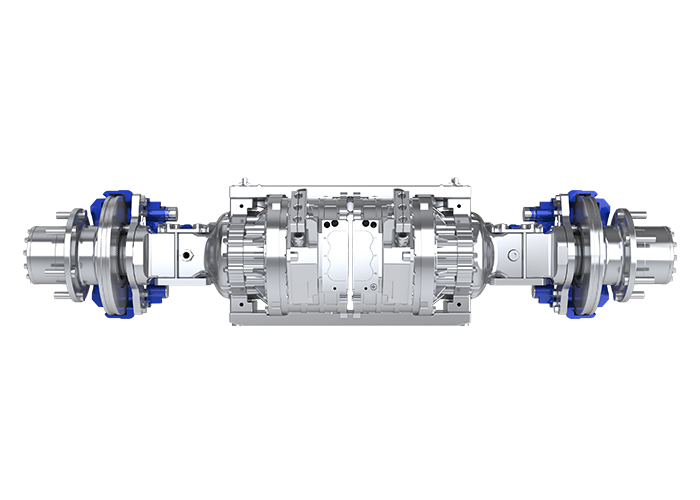
Other players advancing the integrated e-axle technology are Hangzhou Contemporary e-Drive Technology Co., Ltd. As China-based supplier for the complete range of electric drive axles for medium to heavy-duty EVs, Hangzhou Contemporary e-Drive Technology Co., Ltd. follows an engineering approach to design high-performance and compact electric drive units.By engaging in joint R&D activities with OEMs to enhance torque density of their e-axle solutions and by using simulation for validation, Hangzhou Contemporary e-Drive Technology Co., Ltd. is able to reduce the development period for prototypes while maintaining required reliability for use by commercial vehicle operators for fleet operations worldwide.
Conclusion
The debate between the use of central drives or in-wheel motors for heavy-duty vehicles is slowly coming to an end with most parties agreeing that the use of integrated electric drive axles will be the preferred option for future heavy-duty EVs. The highest form of integration will yield efficiency, simplicity in production and reduced life cycle cost – key factors for future purchases in the fleets sector. It has already been proven in practice for various applications in the logistics and public transport sectors, thereby signifying not a marginal development but rather a total redesign of the drivetrain of an EV from a power delivery perspective. Suppliers such as Hangzhou Contemporary are currently refining the solutions with large amounts of data and collaborate with global OEMs. Adoption by 2026 appears to be a given and an inevitable development.
FAQs
1. What is a high-integration electric drive axle?
A high-integration electric drive axle is a combination of a motor, inverter, gearbox and differential. It is installed as a single unit on the axle housing of a vehicle. By installing all the necessary components for an electric drive in a compact space, it is possible to reduce weight while at the same time optimizing efficiency of the overall drivetrain within the EV powertrain system.
2. How does an integrated e‑axle compare to central drives regarding maintenance?
Integrated e‑axles require less maintenance as fewer parts are rotating. No long prop shafts and no external gearbox require lubrication or the frequent check for wear.
3. Are integrated e‑axles also suitable for all types of heavy-duty applications?
Integrated e‑axles are most efficient for medium-to-heavy trucks and buses under constant load. However, for extreme off-road applications, more flexibility by using e‑axles in a modular design is recommended in order to easily replace damaged components.
4. What are the cost savings potential for a fleet manager by implementing an integrated design?
Studies with fleets show potential TCO savings of 10% to 15% over a 5 year period. This is achieved by lowering the energy consumption and by spreading non running maintenance activities over a larger number of vehicles, thus reducing down time for service.
When can we expect integrated electric drive axles to become mainstream worldwide?
Market prognoses suggest that by late 2026–2027 more than half of newly produced heavy-duty trucks worldwide will be equipped with new e-drive axles of high integration as standard. This will apply to trucks offered on the markets in Europe, North America as well as Asia-Pacific.