
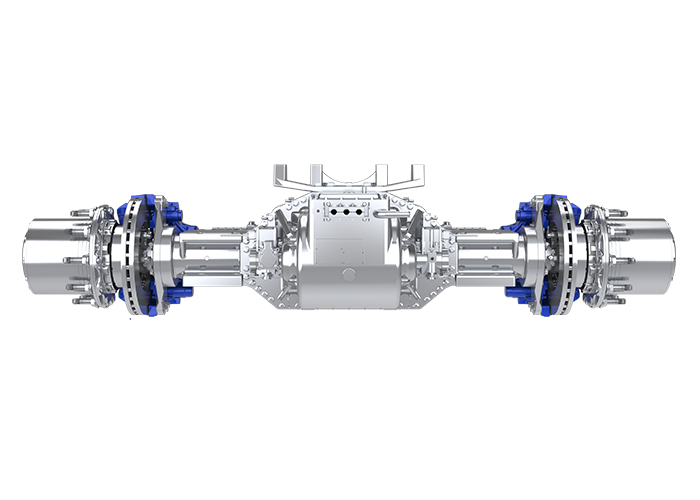
A heavy truck that leaves a depot at full load asks something very different from its drivetrain than the same truck cruising at highway speed an hour later. At launch, wheel torque matters. On a long, steady section of road, keeping the motor in a more suitable operating range becomes increasingly important. Trying to cover both ends of that duty cycle with one fixed reduction ratio can force compromises elsewhere in the drivetrain. A multi-speed e-axle gives engineers another option, but it also introduces more hardware, calibration work, and shift-control requirements. The useful question is therefore not whether two speeds are better than one. It is whether the vehicle operates across a wide enough range for the extra ratio to solve a real problem.
Why Does a Single Ratio Become Difficult for Heavy-Duty Applications?
A reduction ratio affects both wheel torque and motor speed. Choosing a shorter ratio increases torque multiplication at the wheel, which helps when a loaded truck starts from rest or climbs a grade. The tradeoff appears later. At higher road speeds, that same ratio can keep the motor turning faster than necessary.
A taller ratio shifts the compromise in the other direction. Highway operation may become easier on the motor, but launch performance and gradeability have to be checked again. A larger motor can sometimes compensate, although that choice may bring additional weight, packaging demands, cooling requirements, and cost.
For a commercial vehicle, these tradeoffs are rarely judged from one operating point. A logistics truck may leave a terminal, move through urban traffic, merge onto a highway, climb a gradient, and spend several hours at cruising speed before returning to low-speed operation. The ratio has to serve the whole route.
Start With the Route Before Discussing Gear Count
The first useful inputs are therefore vehicle and route data: gross vehicle weight, driven axle load, tire size, required launch performance, gradeability, maximum speed, typical cruising speed, and the proportion of time spent in different operating conditions.
This matters because “heavy-duty logistics” is not one duty cycle. A regional delivery truck with repeated acceleration events has different needs from a tractor that spends most of its working day on an expressway. Before narrowing the architecture, engineers can use broader electric drive technology information to understand how the drivetrain is expected to fit into the vehicle as a system.
Where Can a Multi-Speed E-Axle Remove the Compromise?
A multi-speed arrangement gives the drivetrain more than one mechanical relationship between motor speed and wheel speed. In practical terms, a lower ratio can be used when stronger wheel torque is needed, while another ratio can support operation at higher road speed without keeping the motor in the same high-speed region.
That sounds simple, but the value depends on how often each ratio is actually useful. Adding a second speed to solve a condition that occurs for only a few seconds during an entire route may not justify the additional transmission hardware. The picture changes if the vehicle regularly moves between high-load starts and long high-speed sections.
Think in Operating Zones, Not Peak Numbers
Peak motor power is an easy figure to compare and a poor basis for ratio selection on its own. Two systems with similar peak ratings can behave quite differently once motor speed, wheel torque, continuous output, and road speed are considered together.
A practical review normally begins with several representative conditions:
| Vehicle Condition | What Needs to Be Checked |
|---|---|
| Full-load launch | Available wheel torque |
| Sustained grade | Continuous torque and thermal condition |
| Urban acceleration | Motor operating range and shift frequency |
| Highway cruise | Motor speed at normal road speed |
| Maximum vehicle speed | Motor-speed margin |
| Long-duration operation | Continuous system capability |
This exercise often exposes the real issue quickly. If one ratio satisfies all of these cases with reasonable margins, adding another gear may bring little value. If the launch requirement pushes the ratio one way while highway operation clearly favors another, the case for a multi-speed layout becomes much stronger.
OEM teams comparing drivetrain approaches can also refer to existing commercial vehicle industry insights when reviewing how e-axle architectures are being applied in heavy-duty vehicles.
What Should OEMs Check Beyond Start-Up Torque?
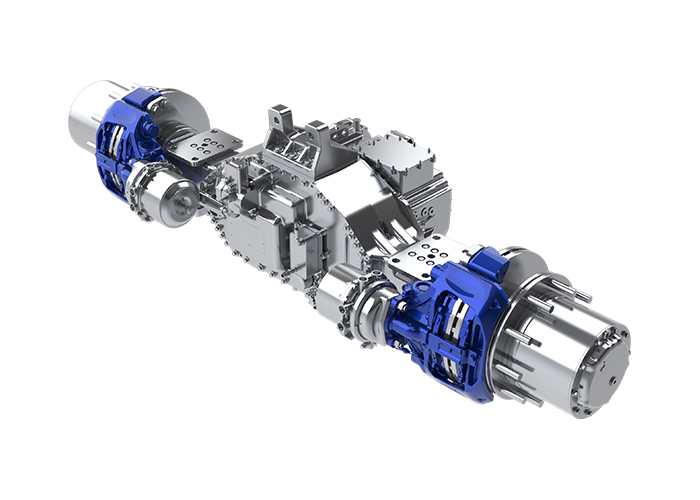
Launch performance tends to attract attention because it is easy to feel during a vehicle test. For fleet operation, however, what happens after the truck is moving can matter just as much.
Continuous torque deserves particular attention. A motor may deliver high peak torque for a short period, yet a long climb or repeated acceleration sequence is governed by what the drive system can sustain thermally. Cooling, motor temperature, inverter limits, drivetrain thermal management and durability validation, and the duration of the load all become relevant.
The same logic applies to efficiency. A quoted maximum efficiency says little about how much time the vehicle actually spends near that operating point. Engineers need to know where the motor will run during the route that matters commercially.
A Highway Vehicle Can Expose a Poor Ratio Choice
Consider a truck that spends most of its daily mileage at a stable road speed. If its fixed ratio was chosen mainly to guarantee strong launch torque, the motor may remain at a relatively high speed for hours. Even a modest loss repeated over long-distance operation becomes more important than it would on a short urban route.
A multi-speed e-axle may move that highway operating point, but the complete system still needs to be assessed. Gear meshes, bearings, lubrication, actuator hardware, and shift events introduce their own losses and demands. The right comparison is therefore between complete drivetrain behavior in the actual duty cycle, not between “one gear” and “two gears” as isolated concepts.
This is also why buyers should ask suppliers for operating-range discussions rather than only a peak torque and peak power sheet.
How Much Should Shift Behavior Influence the Decision?
Once a second ratio is added, the shift itself becomes part of drivetrain performance. A commercial vehicle may need to change ratios while carrying substantial load, so shift quality cannot be separated from torque delivery.
The concern is not simply whether a shift happens quickly. Engineers also need to look at what happens to drive torque while the ratio changes, whether the vehicle experiences a noticeable interruption, how gear engagement behaves under load, and how often shifts occur during the target route.
An aggressive strategy can shorten the event but place more demand on the transmission. A conservative strategy may be mechanically gentler but less suitable when the vehicle needs uninterrupted pulling capability. Neither approach can be judged without the vehicle around it.
Test the Awkward Conditions
Prototype work should include situations that are less comfortable than a flat, unloaded test route. Loaded acceleration, grade entry, repeated upshifts and downshifts, changes in accelerator demand, and long-duration running reveal much more about the suitability of a multi-speed layout.
Shift maps also need to make sense for the application. If the system repeatedly moves between ratios because the normal operating point sits near a shift boundary, the calibration may need another look. A gearbox that looks efficient on paper can become irritating or inefficient if it is constantly hunting between gears.
Published information on CDTL heavy-truck applications shows that distributed drive systems can incorporate shift-control strategies intended to maintain power delivery through gear changes. For an OEM, the broader lesson is useful: gearbox hardware and shift control should be reviewed together rather than purchased as separate topics.
When Is a Multi-Speed E-Axle Actually Worth Choosing?

There is no technical reason to add a gear simply because a multi-speed system sounds more advanced. If a single ratio already covers launch, climbing, cruising, and top-speed requirements within acceptable motor and thermal limits, simplicity has value.
A stronger case appears when the vehicle is being pulled in two directions by its duty cycle. High loaded-start torque may call for one ratio, while long-distance cruising clearly benefits from another motor-speed range. That kind of repeated conflict is exactly what ratio flexibility is meant to address.
The final decision should include more than energy consumption. Packaging space, transmission mass, control effort, durability, serviceability, production cost, and calibration workload belong in the same discussion. A small gain at one operating point is unlikely to justify complexity across the entire vehicle program; a repeated gain across thousands of operating hours is a different matter.
Compare Vehicle-Level Benefit, Not the Number of Speeds
One useful way to frame the decision is to ask what problem disappears after the second ratio is added. Does the motor no longer need to be oversized for launch? Does highway motor speed fall into a more suitable range? Does the vehicle meet gradeability without giving up the desired cruising condition?
If the answer is vague, the architecture probably needs more analysis. If the vehicle data shows the same conflict repeatedly, there is a much clearer engineering case.
Before RFQ release, it is worth giving suppliers the actual vehicle envelope rather than asking for a generic multi-speed e-axle: loaded mass, axle load, tire radius, target launch performance, gradient requirement, cruise speed, maximum speed, route profile, cooling conditions, and expected annual operating pattern.
Engineering Support for E-Axle Projects
When ratio selection begins affecting motor sizing, thermal limits, shift behavior, and complete-vehicle performance at the same time, the project has moved beyond a simple component comparison. Hangzhou Contemporary e-Drive Technology Co.,Ltd. works on distributed electric drive systems and vehicle-level integration for new energy commercial vehicles. For heavy-duty logistics projects, OEM teams can review the EA5000N distributed electric drive axle through the company’s heavy-duty logistics application information and discuss motor configuration, ratio matching, shift control, axle load, route profile, installation conditions, and continuous operating requirements against the real vehicle rather than selecting the drivetrain from a single performance figure.
Conclusion
A multi-speed e-axle is useful when one fixed ratio creates a repeated conflict between low-speed wheel torque and higher-speed operation. That conflict has to be demonstrated with vehicle data, not assumed from the gearbox layout. Loaded starts, sustained grades, cruising motor speed, continuous output, thermal behavior, and shift quality all deserve attention before the architecture is frozen. For OEMs, the right question is simple: does the extra ratio remove a real duty-cycle limitation strongly enough to justify the added system complexity?
FAQs
1. Why might a heavy-duty EV need more than one e-axle ratio?
A second ratio can help when strong low-speed wheel torque and efficient higher-speed operation place conflicting demands on a single fixed reduction ratio.
2. Does a multi-speed e-axle always save energy?
No. The result depends on the duty cycle, motor operating points, transmission losses, shift frequency, thermal conditions, and how much time the vehicle spends in each ratio.
3. Which vehicle data matters most before selecting gear ratios?
Gross vehicle weight, axle load, tire size, required launch performance, gradeability, cruising speed, maximum speed, motor operating range, and route profile are key inputs.
4. Why should OEMs look at continuous torque instead of peak torque alone?
Peak torque describes short-duration capability. Long climbs, repeated acceleration, and sustained heavy operation depend more heavily on continuous output and thermal performance.
5. What should be tested on a multi-speed e-axle before production?
Loaded launch, grade climbing, highway cruising, repeated shifting, torque continuity, thermal behavior, motor speed, and long-duration operation should all be included in vehicle-level validation.