
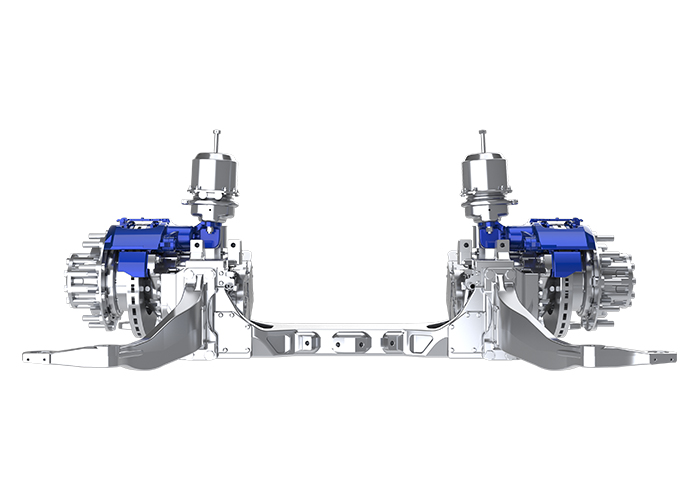
Fleet electrification looks simple in a presentation: replace diesel power, add batteries, build chargers, and scale. A loaded truck exposes the harder part. Battery mass cuts into payload. Axle loads shift. Cooling demand climbs on long grades. A drivetrain that behaves well in city traffic may waste energy on highway work. Once hundreds of vehicles are involved, those details become operating cost. Heavy-duty fleet electrification therefore depends as much on vehicle architecture as it does on charging infrastructure.
Why Does Payload Become a Scaling Constraint So Quickly?
A heavy truck earns money by moving freight. Every kilogram assigned to the electric powertrain has to justify its place on the vehicle.
Where does the weight penalty actually come from?
The battery is only the obvious part. Motors, gearsets, axle housings, inverters, cooling loops, high-voltage cables, mounts, and protection structures all contribute. Spread those components around the chassis and additional brackets and interfaces appear as well.
The problem becomes visible near legal axle and gross-weight limits. Extra drivetrain mass may reduce revenue-generating payload or force batteries into a different position, affecting traction and maintenance access.
Integration does not make mass disappear. It can, however, remove duplicated hardware and shorten the mechanical power path, giving engineers more freedom to decide where the remaining weight belongs.
Why can adding battery create its own range problem?
More battery increases stored energy, but it also increases the mass carried through every mile. On grades and repeated acceleration, that penalty is difficult to ignore.
Range should therefore be calculated after drivetrain efficiency, regenerative recovery, route elevation, payload, and thermal limits are understood. A truck spending most of its day in an inefficient part of the motor map will not become well optimized simply because another battery module is installed.
For fleets, the useful number is energy consumed while performing the route—not battery capacity by itself.
What Happens When Chassis Space and Axle Loads Start Competing?
The area between the frame rails is already busy. Batteries must coexist with suspension components, steering hardware, air systems, cooling circuits, cross-members, and service clearances.
Why can packaging become the hidden bottleneck?
Some electric layouts still use separate motors, gearboxes, prop shafts, differentials, and related mounting hardware. Every interface consumes length and leaves another component that must be reached during assembly or repair.
An integrated e-axle brings more of the drive function toward the axle. The practical gain is the space left elsewhere. A continuous battery bay may be more useful to the vehicle designer than several small cavities scattered around the frame.
Even modest dimensional changes matter. A few centimeters can determine whether a battery enclosure clears a cross-member, whether cooling pipes remain serviceable, or whether a body builder has to redesign surrounding equipment.
Why can a legal-weight truck still carry the wrong load?
Gross vehicle weight does not show how that weight is distributed. Battery position, drive-axle mass, fifth-wheel location, cargo, and suspension geometry determine individual axle loads.
Poor distribution can reduce usable payload even when the total vehicle remains within its legal limit. It also influences traction, tire loading, and braking.
For that reason, e-axle placement and battery placement should be developed together. Installing the drivetrain late in the chassis program often means solving one packaging problem by creating another.
Why Can One Electric Drivetrain Fit One Route and Miss Another Completely?
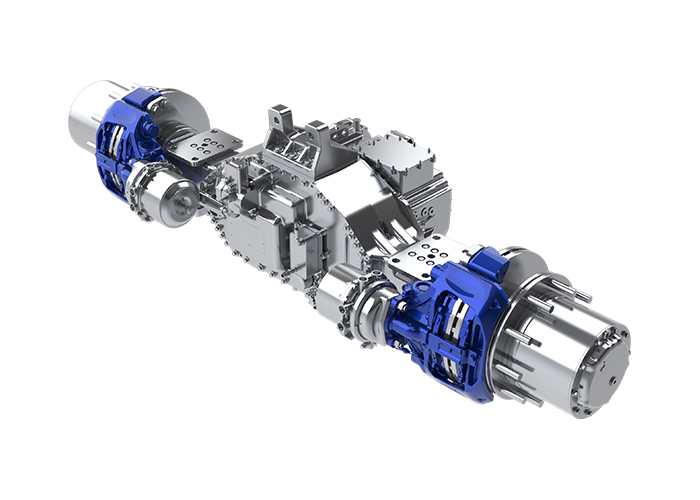
A refuse truck and a long-haul tractor may both be heavy commercial vehicles, but their working lives have little in common. The powertrain sees that difference every minute.
Which duty-cycle details actually change the hardware choice?
Urban delivery involves repeated starts and frequent opportunities for regeneration. Highway logistics spends long periods near cruising speed. Mountain transport demands sustained torque. Mining combines low speed, heavy load, dust, grades, and difficult thermal conditions.
Those operating patterns call for different gear ratios, motor operating regions, cooling capacity, and braking strategies.
Peak torque gets attention because it is easy to publish. Continuous torque can matter more. A truck climbing for ten minutes cannot rely on a short-duration peak rating intended for acceleration.
Buyers should look at torque-speed curves and efficiency maps, then ask where the intended vehicle will actually operate on them. One headline motor-power figure says very little about that.
Can an electric truck still become difficult to maintain?
Certainly. Removing an engine does not automatically produce a service-friendly vehicle.
An electric architecture can still contain inaccessible gearsets, awkward coolant connections, exposed electrical interfaces, or components that require other chassis systems to be removed first.
High integration is useful when it reduces mechanical interfaces without making routine service harder. Fleet workshops need to know what can fail, what can be replaced independently, and how much dismantling is required to reach it. Downtime does not care whether the failed component is electric or mechanical.
How Can Fleets Electrify Without Replacing Every Tractor at Once?
For many operators, the technical case for electrification arrives before the budget for wholesale fleet replacement. A tractor with useful life remaining is still an asset.
Where do conversions and powered trailers fit?
Fleet electrification does not have to follow one route. New battery-electric trucks can operate alongside converted vehicles and electrically assisted trailers where the duty cycle supports them.
A powered trailer creates an interesting middle ground. Electric drive and regenerative capability can be added on the trailer side while the operator continues using suitable existing tractors. It is not the same as replacing the combination with a purpose-built BEV, nor should it be evaluated that way.
Retrofit can also suit controlled applications where route, chassis condition, and operating load are predictable. The difficult work lies in brake coordination, axle loads, controls, cooling, and vehicle integration—not simply fitting an electric axle underneath an existing frame.
Why is a staged rollout technically useful?
Early vehicles generate data that simulations cannot fully provide. The fleet sees where regeneration actually occurs, where energy consumption jumps, what happens in winter or on grades, and how much thermal margin remains after hours of work.
That information may change the next specification.
Perhaps the fleet needs a different ratio rather than a larger battery. Perhaps cooling is the real constraint. Perhaps one route is ideal for electrification while another should wait.
A staged program turns those discoveries into engineering inputs instead of expensive surprises across the whole fleet.
What Should OEMs and Fleets Settle Before Scaling the Architecture?
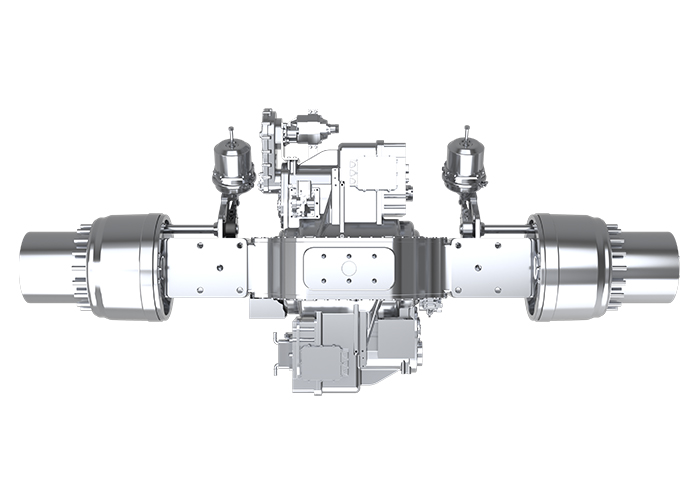
Battery, drivetrain, braking, controls, suspension, and cooling do not operate as separate systems once the truck starts moving. They exchange limits continuously.
Which vehicle data should come before e-axle selection?
Begin with loaded mass, axle loads, route distance, elevation profile, gradeability, cruising speed, launch requirement, regenerative opportunity, battery power limits, and available installation space. Include continuous thermal demand.
Only then does it make sense to compare wheel torque, gear ratio, motor speed range, continuous output, efficiency map, lubrication, sealing, cooling, and brake integration.
Software responsibilities need the same clarity. Torque commands, traction control, regenerative braking, fault response, and limp-home behavior may cross several controllers. Waiting until prototype testing to decide who owns those functions usually costs time.
What makes a supplier proposal technically useful?
A useful proposal explains its assumptions. It does not stop at maximum power or peak efficiency.
OEM teams need to know where the axle operates efficiently, how long high output can be sustained, which cooling conditions were assumed, and what remains to be engineered at vehicle level.
Component changes also matter once production starts. A revised gear ratio, bearing, motor winding, inverter calibration, lubricant, or software version may alter vehicle behavior without changing the outside appearance of the axle. Formal change control is therefore part of fleet reliability, not administrative paperwork.
How Can an E-Axle Partner Support Heavy-Duty Fleet Electrification?
항저우 현대 e-드라이브 기술 유한회사 develops advanced e-axle solutions for heavy trucks, buses, smart trailers, mining vehicles, and other new-energy commercial platforms. Project work can be directed from vehicle mass, axle load, route grade, torque at wheels, battery packaging, thermal management, suspension arrangements, braking systems, and control hardware to drive a particular motor power target down. Prototype assessments should include packaging, efficiency at great driving cycles, thermal performance, torque-assist coordination, driveability, and serviceability. Finalization of mechanical integration, software allocations, validation benchmarks, component requirements, verification protocols, traceability, and change control to freeze the powertrain architecture for vehicle launch by original equipment manufacturer (OEM) teams prior to high-volume production is necessary if subsequent vehicle variants are to be developed around the same drivetrain architecture.
결론
Heavy-duty fleet electrification stalls when the truck stops working as a commercial vehicle. Excess mass removes payload, poor packaging consumes battery space, the wrong ratio wastes energy, and mismatched hardware reaches thermal limits too easily. Better drivetrain architecture tackles several of these problems before another battery module is added. The objective is not merely to replace diesel propulsion. It is to keep freight capacity, range, uptime, and serviceability intact while changing how the vehicle is powered.
자주 묻는 질문
1. Why can more battery hurt heavy-duty fleet electrification?
A larger battery increases stored energy but also adds mass, cost, and packaging pressure. If drivetrain efficiency is poor, the vehicle may sacrifice payload while consuming additional energy to carry that battery.
2. How can an e-axle create more usable chassis space?
An e-axle concentrates drive functions closer to the axle and can remove separate driveline components. The released frame area may then be used for batteries, cooling hardware, or vocational equipment.
3. Why does duty-cycle matching matter for an electric heavy truck?
Urban, highway, mountain, construction, and mining routes place different demands on gearing, continuous torque, cooling, regeneration, and motor speed. One drivetrain configuration rarely suits every operating pattern equally well.
4. Can a fleet electrify without replacing all existing diesel tractors?
Yes. Depending on the application, new BEVs can be introduced alongside suitable vehicle conversions or powered trailers, allowing operators to electrify selected routes while retaining serviceable assets elsewhere.
5. What should buyers review before approving an advanced e-axle solution?
Review torque-speed curves, efficiency maps, continuous ratings, gear ratio, axle mass, cooling requirements, regenerative capability, controls, service access, software responsibility, validation criteria, and component change-control procedures.